

Cornell's Seven Elements of Ethics and Compliance Excellence
Effective and resilient ethics and compliance programs are comprised of seven core elements.
Cornell strives to incorporate the following elements into its ethics and compliance programs:
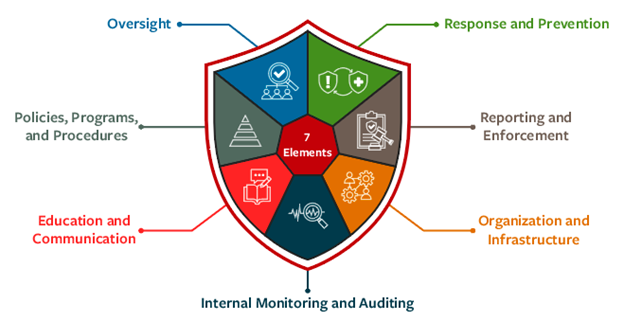
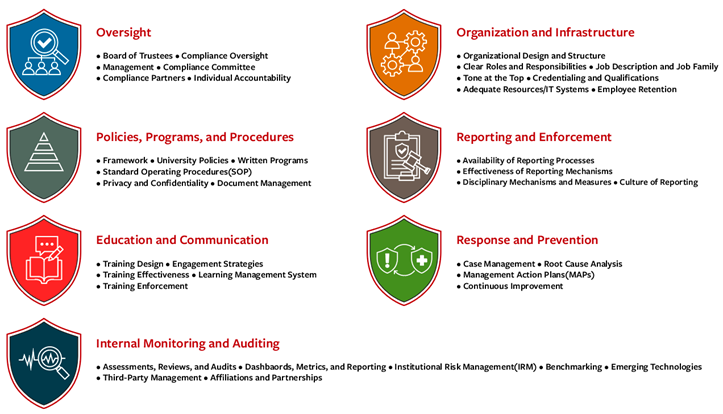
The seven elements, detailed below, serve as a structured resource to support compliance obligations and mitigate risk across the university while providing a scalable roadmap that aligns expectations with both risk level and program maturity.
Oversight
Oversight provides clear accountability and informed decision-making for operational, compliance and ethics obligations and internal governance. The Board of Trustees, Compliance Managers, Councils and Committees, University Compliance Office, and Compliance Partners play critical check and balance roles in oversight and accountability for compliance obligations.
Policies, Programs, and Procedures
The 3P framework translates legal and ethical expectations into clear, practical guidance for the Cornell community by establishing a structured hierarchy, spanning university‑wide ethical standards, policies, written programs, and unit procedures, that collectively define expectations and support the consistent execution of compliance responsibilities.
Education and Communication
Education and communication support individuals’ understanding of their compliance responsibilities and how to fulfill them through ongoing, multi‑channel engagement rather than one‑time instruction. Compliance‑focused trainings, tabletop exercises, partner meetings, and workshops provide structured opportunities to convey and reinforce expectations, build shared understanding, and identify gaps or emerging needs. This approach is further strengthened by consistent communication practices, as well as the tracking and enforcement of required training to promote accountability and sustained awareness across the Cornell community.
Internal Monitoring and Auditing
Internal monitoring and audits are leveraged to proactively identify risks, gaps, and emerging issues before they escalate. Risk assessments, assurance activities, institutional risk management integration, and audits provide systematic approaches to evaluate whether compliance obligations are being managed in alignment with university expectations. These efforts are strengthened through the use of metrics and reporting to inform decision‑making, as well as close integration with Institutional Risk Management to promote consistency, visibility, and a coordinated, enterprise‑wide approach to risk and compliance oversight.
Organization and Infrastructure
Organization and Infrastructure establishes the foundation for effective compliance by supporting programs that are appropriately structured, staffed, and resourced. This includes defining clear roles, reporting lines, and decision‑making authority to promote accountability and alignment across the institution. It also emphasizes the importance of qualified personnel with the appropriate expertise to oversee and implement compliance responsibilities, supported by adequate resources, systems, and tools necessary to sustain operations, enable effective oversight, and advance scalable program growth aligned with institutional needs and risk.
Reporting and Enforcement
Reporting and Enforcement support non-compliance identification and consistent accountability through integrated mechanisms, including various accessible reporting channels, that protect against retaliation and uphold fair, consistent enforcement standards.
Response and Prevention
Response and Prevention focus on correcting issues promptly and reducing the likelihood of recurrence through structured mechanisms such as Management Action Plans (MAPs) and continuous improvement initiatives. These efforts are guided by timely investigation and documentation, thorough root cause analysis, and an ongoing commitment to continuous improvement to strengthen compliance outcomes over time.